
In the study of ordinary differential equations (ODEs), we've learned how to solve equations analytically—especially when the equations are linear or separable. These methods involve transforming the equation into a simpler form and then solving it. However, not all ODEs are so easily managed. Sometimes, the equations are too sophisticated, or the solution methods give us answers that are difficult to interpret. This is where other approaches, like graphical and numerical methods, come into play.
It's important to understand the concept of well-posed problems and the existence and uniqueness of solutions.
1. What Makes a Problem Well-Posed?
In science and engineering, a well-posed problem is essential because it allows us to predict or explain something reliably. A problem is considered well-posed if it meets three criteria:
1. The problem has a solution.
Without a solution, we can't predict anything.
2. The solution is unique.
If there are too many solutions, it’s hard to know which one to use.
3. The solution depends continuously on the problem.
This means that if we make small changes to the initial conditions or the coefficients in our equation, the solution shouldn't change drastically. This is crucial because real-world models aren't perfect, and small errors or changes should lead to small differences in the outcome, not big ones.
When a problem is well-posed, it’s easier to approximate its solution using various techniques. But if it’s not well-posed, finding a reliable solution becomes very difficult, if not impossible.
2. Existence and Uniqueness of Solutions
Let's focus on the existence and uniqueness of solutions to initial-value problems, which are common in differential equations. An initial-value problem involves solving a differential equation with a given starting value.
Consider the general initial-value problem:
Here,
2.1. The Existence and Uniqueness Theorem
The Existence and Uniqueness Theorem is a key result that tells us when a solution exists and whether it's unique. Here’s the theorem in simple terms:
If the function
- Continuous over a certain region in the
- Differentiable with respect to
- The derivative with respect to
Then, for any initial point
This means that if our function
2.2. Examples to Illustrate the Theorem
Example 1: A Non-Solvable ODE
Consider the equation:
with the initial condition
Here,
Since these conditions are met, the theorem guarantees that for any initial point
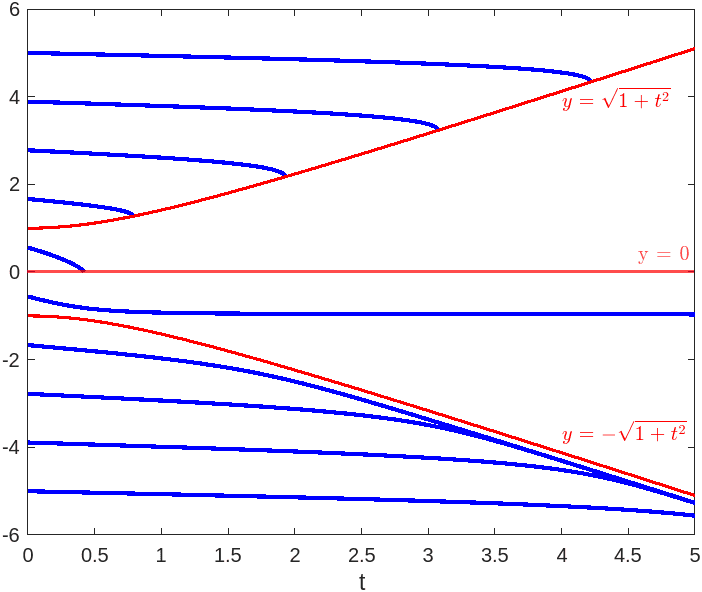
1. Boundary curves and regions:
- The curves
2. Region-restricted solutions:
- The solutions are confined to the specific region in which the initial value lies. That is, solutions starting in a region remain in that region.
3. Solution boundaries:
- Solutions cannot cross or extend beyond the boundaries defined by
4. Initial value dependence:
- The behavior and trajectory of the solution are uniquely determined by the initial value. Depending on where the initial condition falls, the solution remains confined to its respective region.
By breaking the plane into these regions, the behavior of solutions becomes predictable and determined by the starting point, with clear boundaries that cannot be crossed.
Example 2: A Function Defined Everywhere
Now consider:
with the initial condition
In this case,
Since the function meets all the criteria across the entire plane, the theorem tells us that there’s a unique solution for any initial point
2.3. Applying the Theorem to Specific Cases
Example 1: Linear ODE
Consider a linear ODE:
where
Here,
Example 2: Separable ODE
Now consider a separable ODE:
where
In this case, the function
2.4. Examples:
Example 1: Simple Linear ODE
Problem: Solve the initial-value problem
Solution:
1. Identify the function: Here,
2. Check continuity:
3. Apply the Existence and Uniqueness Theorem: The theorem applies, guaranteeing a unique solution for all
4. Solve the equation: The ODE is separable:
Integrating both sides:
Exponentiate to solve for
Use the initial condition
Final solution:
Example 2: Constant Function ODE
Problem: Solve the initial-value problem
Solution:
1. Identify the function: Here,
2. Check continuity: The function is constant, so it's continuous and differentiable everywhere.
3. Apply the Existence and Uniqueness Theorem: Since
4. Solve the equation: Integrate both sides:
Use the initial condition
Final solution:
Example 3: Nonlinear Separable ODE
Problem: Solve the initial-value problem
Solution:
1. Identify the function: Here,
2. Check continuity: The function
3. Apply the Existence and Uniqueness Theorem: Since
4. Solve the equation: The ODE is separable:
Integrate both sides:
Solve for
Use the initial condition
Final solution:
Now, what if the initial value was
which cannot be solved. However, we know that for every
Example 4: Existence but No Uniqueness
Problem: Consider the initial-value problem
Solution:
1. Identify the function: Here,
2. Check continuity: The function is continuous, but its derivative
3. Apply the Existence and Uniqueness Theorem: The theorem does not apply because the derivative is not continuous. This means that even though a solution exists, it might not be unique.
4. Find possible solutions: The equation is separable:
Integrate both sides:
Solve for
Using
Example 5: Initial Condition at a Point of Discontinuity
Problem: Solve the initial-value problem
Solution:
1. Identify the function: Here,
2. Check continuity: The function
3. Apply the Existence and Uniqueness Theorem: The theorem cannot be applied because
In fact, by giving initial values at t = 0, the equation cannot be solved.
Example 6: First-Order Linear ODE
Problem: Solve the initial-value problem
Solution:
1. Identify the function: Here,
2. Check continuity: The function is linear, so it’s continuous and differentiable everywhere.
3. Apply the Existence and Uniqueness Theorem: Since
4. Solve the equation: The ODE can be solved using an integrating factor:
Multiply both sides by the integrating factor:
Integrate both sides:
Solve for
Use the initial condition
Final solution:
Example 7: Separable ODE with Trigonometric Function
Problem: Solve the initial-value problem
Solution:
1. Identify the function: Here,
2. Check continuity: The function is continuous and differentiable everywhere.
3. Apply the Existence and Uniqueness Theorem: The theorem applies, ensuring a unique solution.
4. Solve the equation: The ODE is separable:
Integrate both sides:
Exponentiate to solve for
Use the initial condition
Final solution:
Example 8: Nonlinear ODE with Quadratic Function
To solve the initial-value problem
Let's follow these steps and explore the solution in more detail.
1. Identify the Function
The differential equation is:
2. Check Continuity
The function
3. Apply the Existence and Uniqueness Theorem
Since
4. Solve the Equation
To solve the differential equation, we use the substitution method. Let’s try the substitution
This differential equation is nonlinear and solving it analytically is quite complex. We can solve it numerically or use a software tool for exact solutions.
Example 9: Nonlinear ODE with an Absolute Value Function
1. Identify the Function
Here, the differential equation is
2. Check Continuity
The function
3. Apply the Existence and Uniqueness Theorem
The standard Existence and Uniqueness Theorem for ODEs states that if
4. Find Possible Solutions
We need to find possible solutions for the given initial-value problem. Let's solve the differential equation in different cases:
Case 1:
When
This is a standard first-order linear differential equation. Its solution is:
where
Thus,
Case 2:
When
This is also a standard first-order linear differential equation. Its solution is:
Using the initial condition
Thus,
In both cases, we found that
This is a valid solution. However, because
Example 10: Autonomous ODE with a Quadratic Nonlinearity
Problem: Solve the initial-value problem
Solution:
1. Identify the function: Here,
2. Check continuity: The function is continuous and differentiable everywhere.
3. Apply the Existence and Uniqueness Theorem: The theorem applies, ensuring a unique solution.
4. Solve the equation: This is separable:
Factor the denominator and integrate:
Use the initial condition
Note that if the initial value was either
We notice that
By understanding these concepts and working through examples, you'll gain a strong foundation in determining when and how solutions to differential equations exist and whether they are unique. This knowledge is crucial for solving ODEs, especially when more advanced methods or numerical approaches are needed.