
A person claimed it would be possible to make one of the most impressive fractals ever discovered with no more than a piece of paper and some left and right turns. You would probably think they were kidding. A fractal would normally be something you would see in an equation in some advanced textbook or some corner of some computer lab, not something you can personally recreate. But that is exactly how the Dragon Curve, with its stunning yet elementary fractal pattern, begins.

Just its name, Dragon Curve, evokes the sense that it exists as an outright apparition from some fantasy tale. And, on some level, it unmistakably does. As much a legend as it is a calculation, as much an eye-deceiving trick as it is an artistic representation, the Dragon Curve is an unmistakable icon within the realms of recreational mathematics and artistic examination. It transcends not only because it seamlessly blends realms, but also because it seamlessly integrates what should be mutually exclusive.
This article will lead you on a journey through the origin, generation, personality, and cultural impact of the Dragon Curve. Equally important, it will venture into why this apparently trivial pattern has become so alluring as a method for illustrating fractality. And, more significantly, why it continues with such appeal for mathematicians, artists, programmers, and curious minds.
1. Before the Dragon ~ The Magic of Folding Patterns
We will start with something familiar: folding a piece of paper.
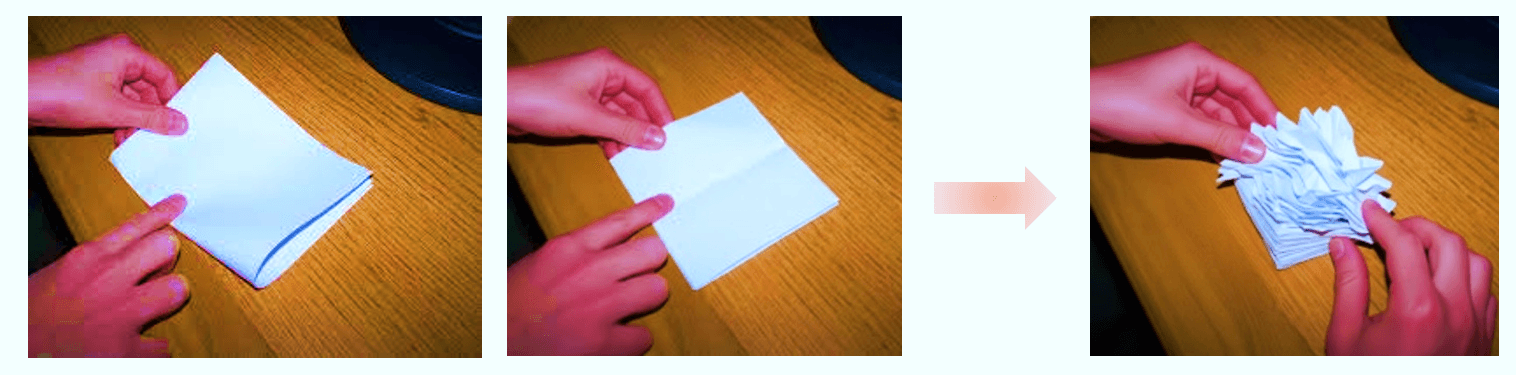
Envision taking a large piece of paper and folding it exactly in half. And then folding it again and again and again, a dozen times. And then, if you unfold it carefully, taking care that all these passes were folded in the direction they should be, there will be a zigzag pattern of left and right turns. It doesn’t amount to much at first.

However, by folding it a whole lot more times, or better yet, having a computer simulate a sequence of hundreds or thousands of these folding steps, this pattern will start to reveal something amazing.
The pattern becomes increasingly complex yet surprisingly regular. It twists and turns around itself without ever crossing. It curls and coils around itself, making beautiful spirals on every scale. And on every scale of magnification, smaller portions of the pattern look like larger portions, giving life to the hallmark trait of fractals, which is self-similarity.
You would expect a sequence of simple folds to produce something predictable. However, it just so happens that this simple folding technique will generate the Dragon Curve, which is perhaps one of the most famous fractals ever.
2. A Fractal Born in a Lab, Not a Cave
Its name implies a mythological antiquity, but the Dragon Curve was not discovered by mystics or medieval illustrators. It was discovered accidentally in the 1960s, and it was discovered by physicists.
John Heighway, Bruce Banks, and William Harter were working at NASA's Jet Propulsion Laboratory on an unrelated problem: efficiently packing data into a computer's memory. Their research put them on the trail of a specific folding pattern, which led them to a very special curve. It became known as a Heighway Dragon, but its common name is Dragon Curve.
Growing a Variation of the Harter-Heighway Dragon

A few years later, Martin Gardner, one of the most prominent mathematicians ever to popularize recreational mathematics, wrote about it for an article in Scientific American. And so a research curiosity became a phenomenon.

From there, it made its way into and infected all sorts of things: artworks, programming projects, textbooks about fractal geometry, tattoo designs, and even Jurassic Park episodes. The Dragon Curve entered mainstream consciousness and escaped from the lab.
The Fractal Curve | Jurassic Park Animation
3. What Makes the Dragon Curve a Fractal?
You don’t have to graph it in order to conceptualize it. Just consider these four properties.
3.1. Self-Similarity
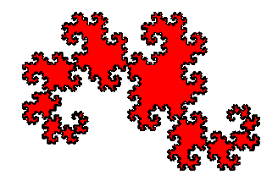
You can zoom in on any small area of a Dragon Curve and discover mini-Dragons lurking within. The pattern repeats at different scales. This is a characteristic of fractals.
3.2. Infinite Complexity from a Finite Rule
The rule for folding is simple: every time, insert a right turn at the center and mirror the pattern. However, this infinitesimal rule forms an endless pattern with boundless detail.
See how the Dragon Curve fractal unfolds!
3.3. Non-Intersecting Path
Unlike scribbles that cross over each other, the Dragon Curve does not intersect itself, although it does loop back over its own area hundreds of times. From a mathematical perspective, it's an incredible feat.
3.4. Fractional Dimension
The Dragon Curve has a fractal Hausdorff dimension approximately equal to 1.52. Not a line (dimension 1). Not a plane (dimension 2). It lives in a strange region in between, like so many fractals. It is these attributes that make the Dragon Curve so significant and so aesthetically pleasing.
4. Creating a Dragon ~ Turns, Rules, and Recursion
There are infinitely many ways to generate a Dragon Curve. It could be done with folding paper, with loop-theory, with rewrite rules, or with complex numbers. But at the foundation of every single path is recursion.
Recursion is using what we have before to make what we have next.
Here’s the central concept:
Play a sequence of turns (L for left, R for right). To get the next sequence, you have to:
Creating a copy of the previous sequence.
Adding one new right turn.
Adding a reversed and mirror copy of the previous sequence.
And that is it. A small rule, and it gives life to a fractal universe.
And with each iteration, the pattern extends, the course winds, and complexity intensifies.
Now let’s give it a try to create a Dragon Curve!

And here we see emergence at work: simple rules giving rise to patterns much more intricate than originally designed. The Dragon Curve represents more than a mathematical set. It represents creativity, more so as it develops or evolves.
If you have an interest in coding, there are several programming languages capable of displaying it on screen within fewer than twenty lines. It's a very satisfying experience watching it develop.
5. Why Recreational Mathematicians Are Attracted to the Dragon Curve
Recreational math depends on puzzles that start simple but have very deep roots. The Dragon Curve puzzle fits this perfectly.
It’s interactive: You can manually start generating the first few iterations.
It’s visually pleasing: something new with every iteration.
You will be surprised: The pattern goes in unexpected ways.
Limitlessly extendable: there’s always another turn to take, another corner to discover, another scale to zoom into.
It encourages play, and sometimes play leads to discovery.
5.1. Dragon Curve as Art ~ Where Math Becomes Muse
Artists prefer these curves because they allow balancing:
Predictability and surprise
Symmetry and wildness
Structure and flow
It lends itself to bold geometric designs, digital wallpapers, textiles, tattoos, animations, and architectural designs. Its self-replicating structure calls for color shifts, line thickness changes, and layering effects.
The Dragon Curve translates rigid mathematics into fluid aesthetics, an appreciation that art and mathematics are not opposing forces but local dialects of an aesthetic language.
5.2. Dragon Curve as Art ~ Where Math Becomes Muse
Artists prefer these curves because they allow balancing:
Predictability and surprise
Symmetry and wildness
Structure and flow
It lends itself to bold geometric designs, digital wallpapers, textiles, tattoos, animations, and architectural designs. Its self-replicating structure calls for color shifts, line thickness changes, and layering effects.
The Dragon Curve translates rigid mathematics into fluid aesthetics, an appreciation that art and mathematics are not opposing forces but local dialects of an aesthetic language.
5.3. What the Dragon Curve Teaches About Life's Patterns
Yes, it’s beautiful. But it also teaches subtle lessons about thinking and the world.
Lesson 01: Complexity doesn’t have to be governed by hard and small actions that lead to masterpieces.
Lesson 02: Things that can seem chaotic may hide intense structures.
Lesson 03: Growth occurs through iteration.
Lesson 04: Remember that perspective matters! While everything looks jagged when you zoom in, beauty may appear once you zoom out.
Do something today. Do something tomorrow. Repeat, and repeat, and repeat again. It’s from repeating that greatness emerges.
5.4. The Dragon Lives On
A world of galaxies, weather simulations, and photo-realistic graphics might make a folding rule curve from the 1960s appear quaint. Nevertheless, it’s easy to see why and how the Dragon Curve has remained a classic, as it teaches us that sometimes it’s beautiful and more impressive to have a simple idea.
It seems alive.
It’s like magic.
It’s a mathematical concept with a personal touch.
But most importantly, it challenges you to: To Fold, to draw, to iterate, to imagine. Fractals are more about curiosity than numbers.
6. Conclusion ~ The Infinity That Lies Within Simplicity
Well, we suppose it. The Dragon Curve is more than beautiful. It speaks volumes about the universe and its unique ability to ‘encode’ complexity within simplicity. It talks about creativity inhering within repetition. It represents math and its surprises if tackled with a novel perspective. Its spirals and curls demonstrate that it’s possible for order to emerge from simple rules, that beauty can emerge from structure, and that structure can emerge from beauty. It’s a playground for mathematicians, a muse for artists, and an invitation for curious people.
And perhaps, for you, a spark, to remind you that sometimes the greatest wonders begin with just one fold.