1. Introduction
Take a moment to envision a world without math.
No GPS directing you on where to turn.
No medical scans show what’s happening inside the human body.
No smartphones, no online streaming services, no predictions based on data analysis, no engineering feats dominating cityscapes.
But here’s the kicker: not one of these things goes away because science has somehow evaporated or technology has imploded or engineering has fallen apart. They go away because mathematics is absent.
In the cluster of letters in STEM, it seems that the “M” in the group always has the least conspicuous connotations. Science receives all the groundbreaking achievements, technology gets all the attention, engineering constructs all the towering buildings, while medicine performs life-saving wonders. In the meantime, math operates backstage, unsought, uncelebrated, yet inalterable.
In this article, it will be discussed why mathematics is so important in science, technology, engineering, and medicine, and why, once understood, it can change your perspectives on math and the world.
2. Mathematics - the Language Behind Every Breakthrough
Mathematics has been called the language of the universe. That’s not just flowery language. It’s true.
Science is the pursuit of knowledge about how the universe works. However, simple observation is not sufficient. Scientists require a language to define patterns, test hypotheses, and make predictions about what might happen in different situations. Mathematics is this language.
When scientists talk about:
motion
energy
temperature
pressure
probability
uncertainty
They are speaking in numbers, equations, and models.
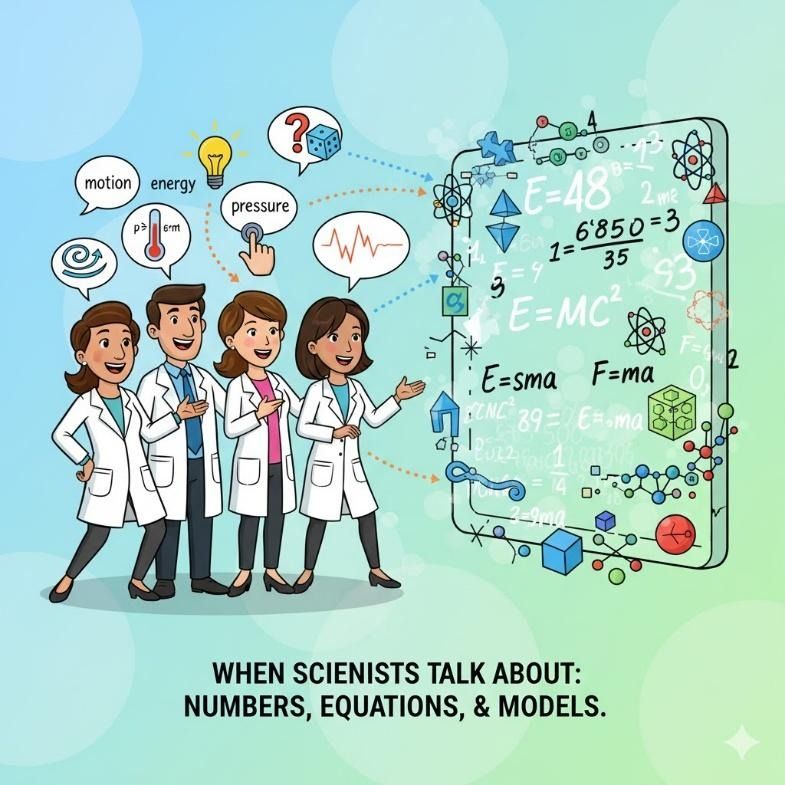
Science would be descriptive, rather than predictive, without mathematics. You could describe what was happening, but not how big, how quickly, how likely, or what would happen then.
3. The M in STEM is Not Optional; it’s Foundational!
It’s tempting to think about STEM in terms of the four pillars. Math is really the foundation that supports all four.
Science relies on math to:
analyzing data
test hypotheses
identify relationships
model systems
verify results
Technology uses math in these ways:
process information
compress data
secure communication
optimize performance
power algorithms
In engineering, math is used to:
design structures
test safety limits
model forces
manage resources
minimize failure
Medicine applies mathematics in the following ways:
interpret medical images
calculate dosages
analyze clinical trials
model disease spread
personalize treatment
Without math in these areas, they do not slow down; rather, they stop.

“M”is more than a letter. It’s the operating system that underlies all things STEM.
4. Mathematics Turns Ideas into Reliable Systems
Ideas are exciting. But it is reliability that makes an idea useful.
Mathematics fills this gap.
Anyone can conceive of a bridge, a medical device, or a software platform. Mathematics deals with the harder questions:
Will it work every time?
How much stress can it handle?
How accurate is the result?
What level of safety does the design provide?
What is the margin of error?
Many engineering disasters, failures in technology, and medical mistakes have been caused by mathematical errors, not imagination.
Math is where ideas obtain credibility.
5. Because Technology Speaks in Math, Not Words
All the taps, clicks, swipes, and scrolls follow mathematical rules.
Technology does not “understand” language or pictures or feelings, as a human being does. Technology understands numbers.
Behind your screen:
Images are matrices of numbers
Videos are composed of coded information streams
Music is depicted as waveforms.
Search results are ranked by probability
The recommendations come from statistics
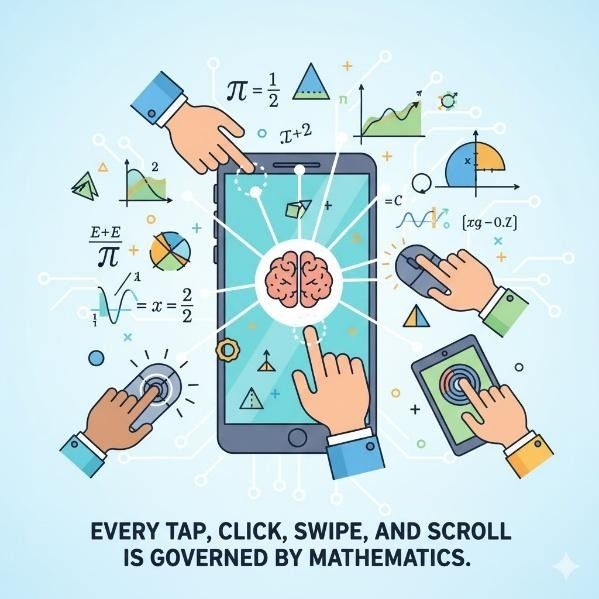
Algorithms, the core of technology, are no more than mathematical procedures carried out at blazing speeds. “Thinking,” even in artificial intelligence, is essentially mathematical in nature. This is because it learns through minimizing mistakes, function optimization, or pattern recognition in numbers from massive amounts of data. At the surface, it may seem intuitive, but beneath the surface, technology is simply mathematics incarnate.
6. Engineering ~ Where Math Meets Reality
This brings us to the fourth similarity, which states that engineering is where numbers meet the physical world.
Prior to any physical constructions being put up, it could be a skyscraper, a vehicle, renewable energy infrastructure, or even a medical device; the result is expressed in the form of a mathematical model.

Engineers ask:
How intense can it be?
How long will it last?
How will the system respond to stress?
What occurs in extreme conditions?
These kinds of questions can’t be answered through trial-and-error processes. These problems demand computation, simulation, and modeling.
Mathematics provides the following facilities to
test designs without physical prototypes
Identify weak points early
cut costs and risks
ensure safety and efficiency
"Engineering without math is a matter of guesswork. But with math, it becomes precision.”
7. Medicine Runs on More Math Than You Think
Medicine has long been associated with the biological sciences, chemistry, and medical intuition. In reality, however, every medical decision and every medical advance involves math.
See below how math applies to medicine:
imaging techniques use mathematical reconstruction

Doses of drugs depend on correct computation
Medical research employs statistics to confirm treatment effectiveness
Disease modeling helps in predicting outbreaks.
Risk assessment helps inform preventive care
Even a simple blood test requires statistical limits, probabilities, and numerical calculations.
Modern medicine today is about more than curing people; it’s about making informed decisions. It’s where math keeps the decision safe.
8. Math Teaches You How to Think, Not Just What to Calculate
Math's most precious gifts to the STEM field are not equations, but mindsets.
Math will train your mind to;
break problems down into components
spot patterns
reason logically
evaluate evidence
test assumptions
cope with uncertainty
All these skills can be found in every branch of STEM.
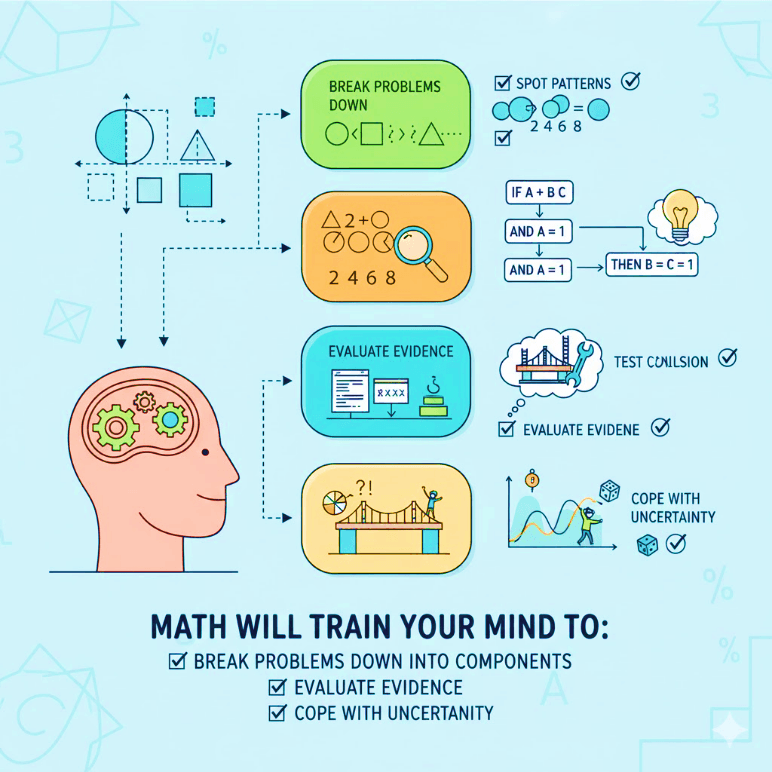
While learning math, you’re learning to solve equations, yes, but that’s only half of the equation. More importantly, you learn to deal with complexity without freaking out.
This is important in research labs, design studios, hospitals, and tech firms alike.
9. The Hidden Math Behind Everyday STEM Moments
A person does not have to be working in a lab or programming computer code to witness the “M” within STEM.
You notice this when:
The GPS determines the shortest path.
Streaming sites offer suggestions for viewing
Fitness trackers analyze activity
Weather apps predict storms
Medical apps monitor health
Online payments remain secure
These systems are perceived as seamless because the mathematics that drives these systems is hidden, and that’s designed.
If math is working well, you hardly even notice it. That’s the power of math.

10. Reasons Why Math Seems Tough, or Why This is Normal
Math can seem scary, but this fear can often stem from how math is taught rather than what math is for.
Math involves abstraction. It requires you to solve problems even before you can observe the answer. Often, this can be somewhat awkward.
But the truth is:
Struggling in math doesn’t mean that a person or a child can’t do the math. It is a sign of learning.
The persistence that will help you solve math problems will catalyze resilience, adaptability, and confidence in all routes in STEM.
Mathematics is not a subject that can be done by itself. It is a subject that is meant to stretch your thinking.

11. The Future of STEM Rests on Mathematical Thinking
As STEM education progresses, mathematics becomes more important.
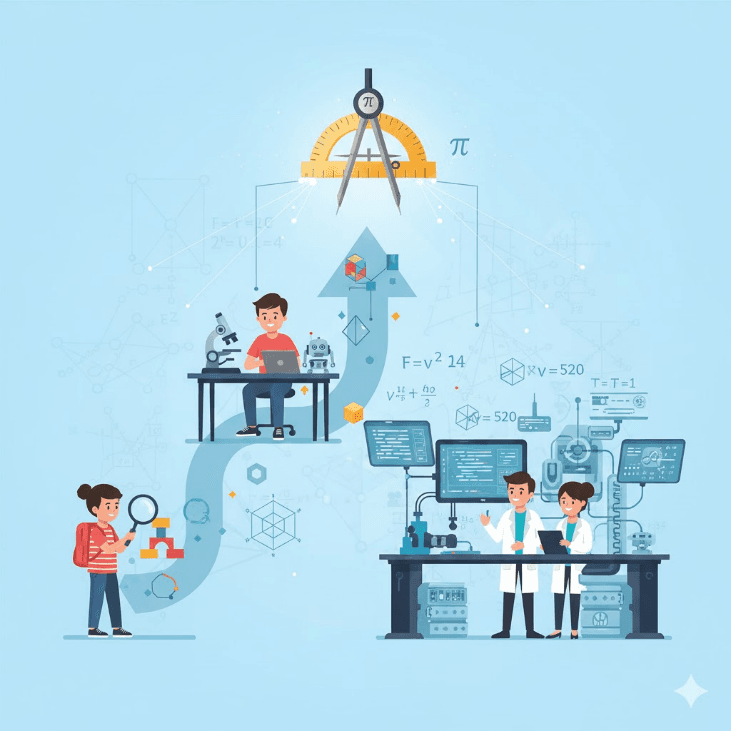
Emerging fields such as:
data science
machine learning
biomedical engineering
climate modeling
sustainable energy
robotics
All rely heavily on mathematical frameworks.
Future problems cannot be solved by memorization. Future problems will be solved by analysis, modeling, and interpreting mathematical ideas.
The “M” in STEM isn’t shrinking. It’s expanding.
12. Seeing the “M” differently
Math is viewed as an obstacle that must be overcome before actual STEM work can begin. The truth is that it is the actual work that makes all other things possible.
It won't steal creativity.
It does not replace intuition.
It does not limit imagination.

Instead, math translates curiosity into structure and power into ideas.
By understanding what the “M” in STEM stands for, you will stop asking, “Why do I need this?”
You can immediately begin asking, “What can I build with this?”
13. Final Thoughts ~ The Quiet Power of the “M”
Even though math is not always apparent, its impact is ubiquitous.
It speaks softly, works all the time, and enables all kinds of things, from lifesaving medical choices to revolutionary technology developments.
Science asks questions.
Technology offers applications.
Engineering constructs the future.
Medicine saves lives.
And Mathematics?
Any of these would not be possible without the help of mathematics.
The next time you see the word STEM, remember that the M isn’t just one letter among four. It’s the silent architect holding the entire structure together.