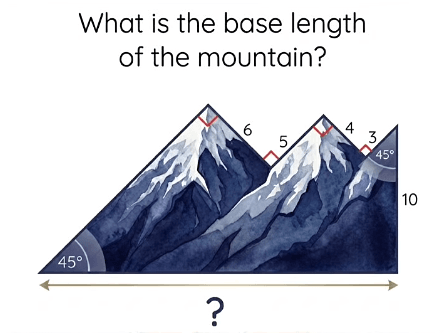
We have explored squares, circles, and triangles, but now it is time to tackle something a little more rugged! With a series of zig-zagging peaks and valleys is a mountain whose base length is still unknown- at least to us until we figure it out. Just like our previous puzzles, underneath the puzzle lies beautiful geometry.
We have a mountain with a base angle of 45^\circ. The surface of the mountain then zigzags through four distinct segments with lengths of 6, 5, 4,\ and 3. Every single peak and valley forms a perfect 90^\circ right angle. Finally, the rightmost edge of the mountain drops straight down with a vertical height of 10. The problem asks us to find the base length.
Let’s look at two different ways to solve this—direct calculation with a step-by-step route, and then a nice solution by one of our followers!
1. Solution 1: By step by step calculation
Because every angle in the zig-zag is 90^\circ, and the starting angle is 45^\circ, every single segment of this mountain is moving at exactly a 45^\circ angle relative to the ground! This means we can break the mountain down into a series of 45^\circ - 45^\circ - 90^\circ triangles.
In a 45^\circ-45^\circ-90^\circ triangle, if the hypotenuse is L, both the horizontal width and vertical height are exactly \frac{L}{\sqrt 2}. This is a key point that will allow us to figure out the base length.
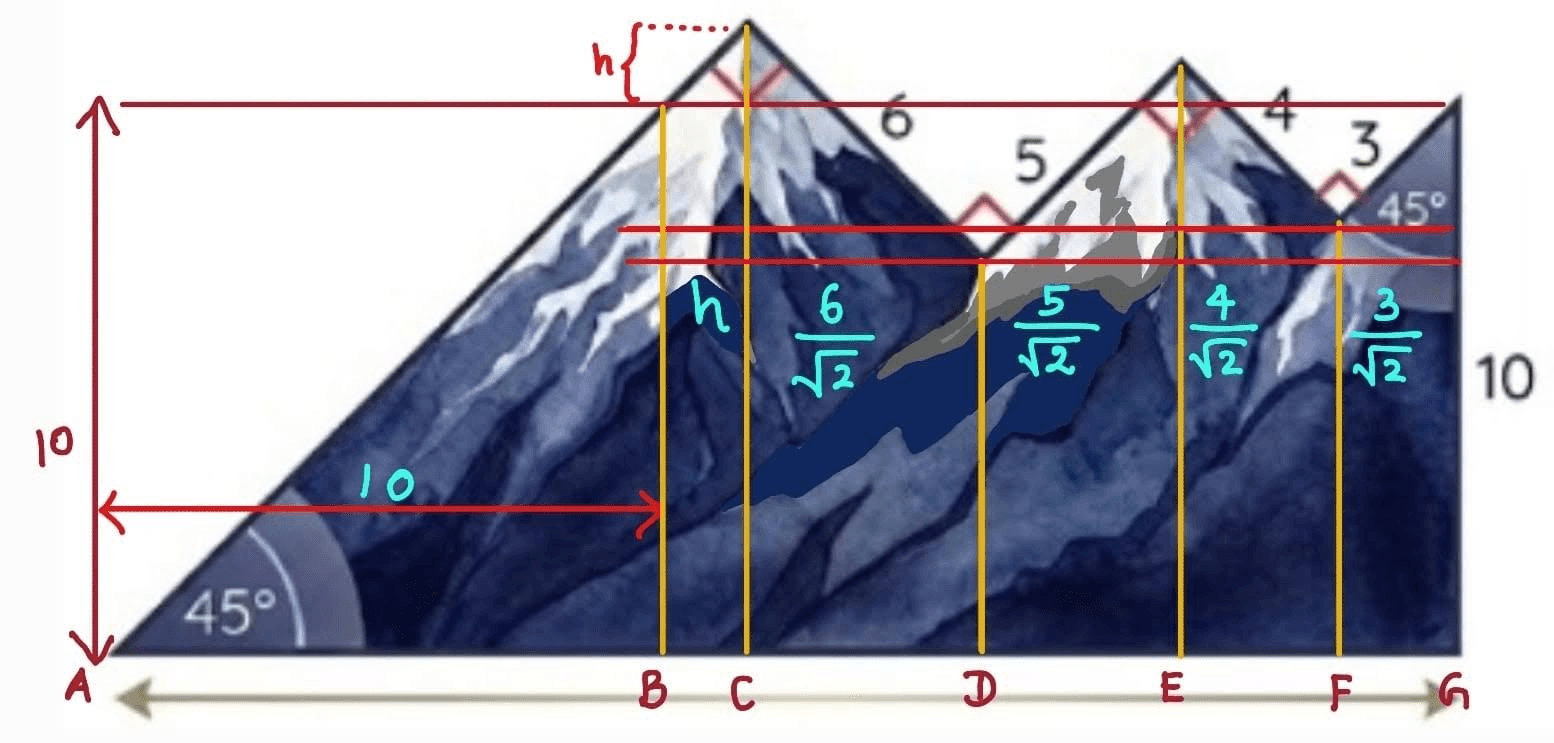
Look at the marked figure below.
The total base length is made up of the smaller segments AB, \, BC, \, CD, \, DE, \, EF, and FG.
Consider the leftmost triangle. It is a 45^\circ - 45^\circ - 90^\circ triangle with height 10. So, AB=10.
To find CD, look at the triangle with hypotenuse 6. As we stated above, it has a base length of \frac{6}{\sqrt 2}. Therefore, CD = \frac{6}{\sqrt 2}.
Similarly, we can find that;
DE = \frac{5}{\sqrt 2}
EF = \frac{4}{\sqrt 2}
FG = \frac{3}{\sqrt 2}
Now, it only remains to figure out the length of the segment BC. Notice that BC=h, which is the height of the smallest top triangular portion immediately after the large left triangle. If we figure out h, then it suffices us to proceed.
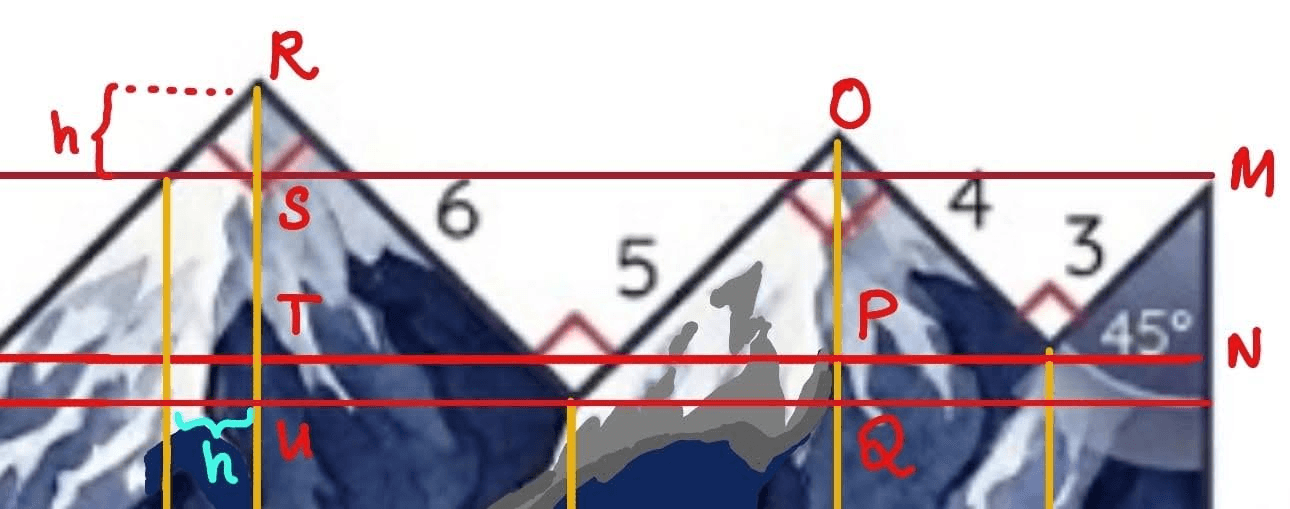
Consider the triangle with hypotenuse 6. The smallest triangle is embedded in this bigger triangle with a hypotenuse of 6. For convenience, look at the zoomed-in figure below.
The right vertical leg MN has length \frac{3}{\sqrt 2}. The middle vertical leg OP has length \frac{4}{\sqrt 2} and OQ has length \frac{5}{\sqrt 2}. So, the segment PQ has a length of \frac{1}{\sqrt 2}.
Now consider the leftmost vertical leg RU. It has a length of \frac{6}{\sqrt 2}. And it is formed by the three segments RS, \, ST, and TU.
Notice that RS is our unknown height h, ST has a height of \frac{3}{\sqrt 2} (being in line with the segment MN), and TU has a height of \frac{1}{\sqrt 2} (being in line with the segment PQ).
Now, if we equate the above relations, we get the following :
Thus, the mountain has a base length of 10+10\sqrt 2 units.
2. Solution 2: An elegant approach
The next solution we have is a fascinating solution given by one of our follower’s (Hữu Hiếu) comment on ourFacebook page. Read further to enjoy its beauty.
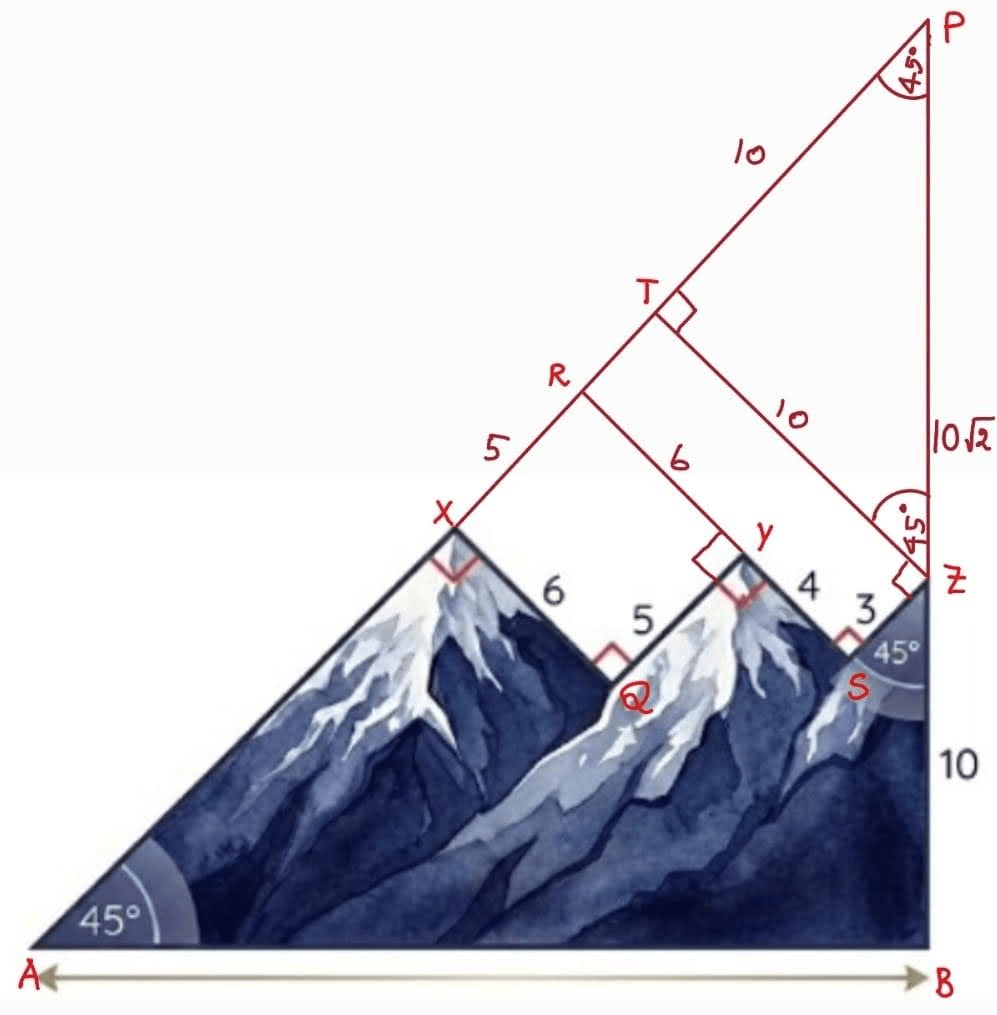
Let the two ends of the base be A and B, as shown above. Also, label the peaks X, \, Y, and Z. Now, let’s do some construction.
Extend the sides AX and BZ such that they meet at the point P. Now, ABP forms a triangle with 45^\circ - 45^\circ - 90^\circ angles. Furthermore, construct rectangles XQYR and RSZT as shown in the diagram given below. Then, we can use the relationship between opposite sides of a rectangle to proceed further.
Since XQ = 6, we know its opposite side, YR = 6 as well.
Similarly, the total segment RS = RY + YS. Since the mountain segment YS = 4, we have RS = 6 + 4 = 10. Therefore, its opposite side TZ = 10.
Now, observe that the top triangle TZP is also a 45^\circ - 45^\circ - 90^\circ right-angled triangle with hypotenuse ZP and TZ = 10. Recall that in a 45^\circ - 45^\circ - 90^\circ angled triangle, the two legs adjacent to the right angle are equal in length. Therefore, TP = 10 as well!
Now apply the Pythagoras' Theorem:
ZP^2=10^2+10^2 = 200.
So,
ZP = \pm \sqrt {200}.
Since we consider the positive value of ZP, we finally get that,
ZP = \sqrt{200} = 10\sqrt 2.
Finally, to get the base length, consider our larger triangle ABP. Since ABP is also a 45^\circ - 45^\circ - 90^\circ triangle, its height is exactly equal to its base length.
The height of the triangle is
BP = BZ+ZP = 10+10\sqrt 2.
Hence, the base length is also 10+10\sqrt 2 units!