We have already seen fascinating puzzles where circles and triangles interact with one another. Let’s have a look at two more puzzles with squares and triangles.
1. The taco and the straw
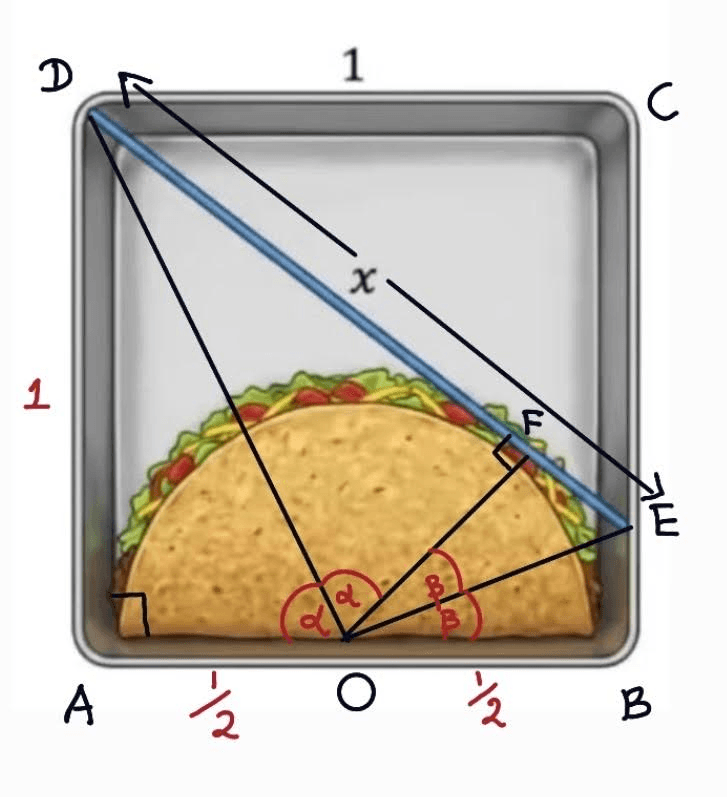
For the solution, we will make use of similar triangles and congruent triangles, specifically the Right-Angle Hypotenuse Side (RHS) case. Look at the diagram below.
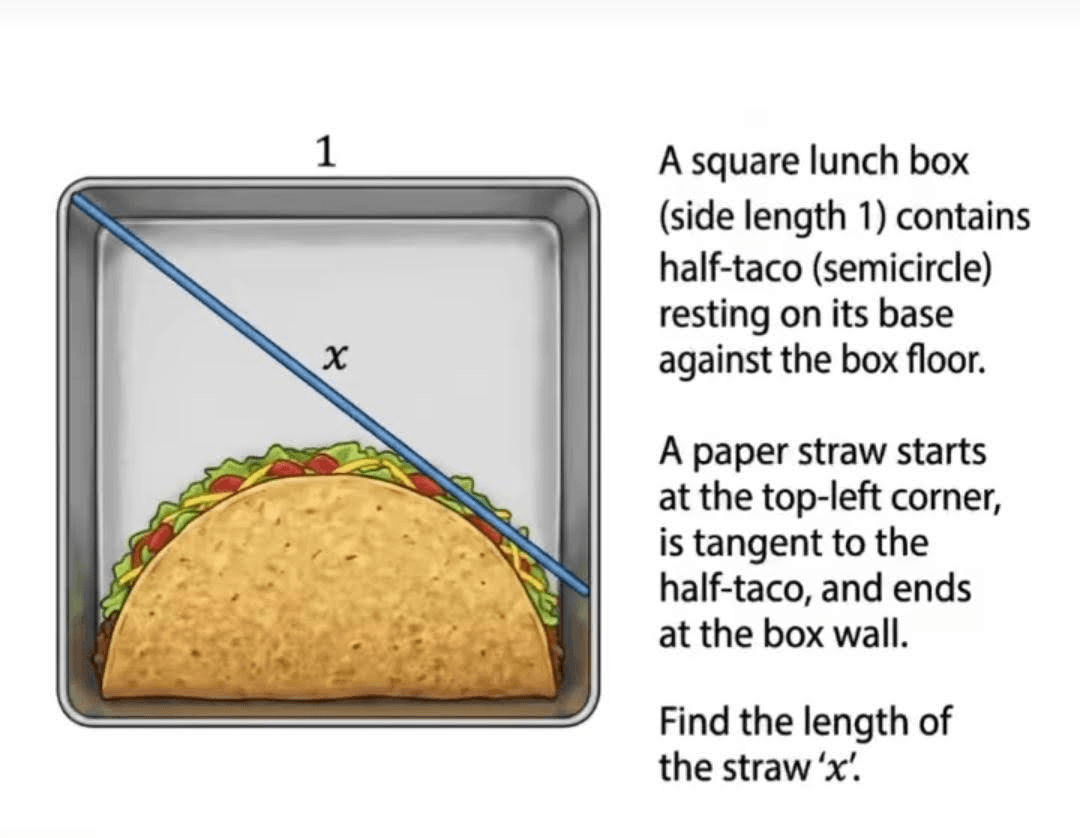
For convenience, we have labelled the figure. The center of the half-taco is O, and the vertices of the square lunchbox are labelled: A, B, C, and D. One end of the straw rests at the point D, and the other end is labelled E. The tangent point of the half-taco and the straw is labelled F in the given figure.
First, consider the triangles \triangle AOD and \triangle OFD.
They are both right-angled triangles and share the hypotenuse side OD. For the \triangle AOD, the side AO has a length \frac{1}{2} (being the radius), and for \triangle OFD, the side OF has length \frac{1}{2} (also the radius). Thus, the two triangles AOD and OFD are congruent under the case of RHS. So, their corresponding angles and sides are exactly the same. Therefore, the angles A\hat{O}D and F\hat{O}D are equal. Let’s call them \alpha.
Now, look at the triangles \triangle OFE and \triangle OEB. Those two triangles are also right-angled triangles with a common hypotenuse side OE. Sides OF and OB are both equal in length with \frac{1}{2}units (being the radius). Thus, these two triangles are also congruent by RHS. Denote the corresponding equal angles F\hat{O}E and E\hat{O}Bby \beta.
To figure out the length xof DE, we will proceed as follows.
Since the triangles \triangle AODand \triangle ODF are congruent, the sides ADand FDare equal in length. Because the box has a side length of 1, FDalso has a length of 1.
Let the length of FEbe x-1 units. Since the triangles \triangle OFE and \triangle OEB are congruent, the sides FE and EB are equal in length. Therefore, EB also has a length of x-1 units.
Now, we can use the geometry of the angles around the center point O to unlock the rest of the problem. Because the bottom of the box (AB) is a straight line, the angles must add up to 180^\circ.
So,
2\alpha + 2\beta = 180^\circ
\alpha + \beta = 90^\circ
\beta = 90^\circ - \alpha.
Since the angle O\hat{D}F is 90^\circ -\alpha, and the angle O\hat{E}F is \alpha , the triangles \triangle ODF and \triangle OEF are similar! Thus, we can use similar triangles to proceed with the solutions. By the similar triangles condition, we have;
We’ve looked at tacos, now let’s look at a classic lunchbox staple: the sandwich.
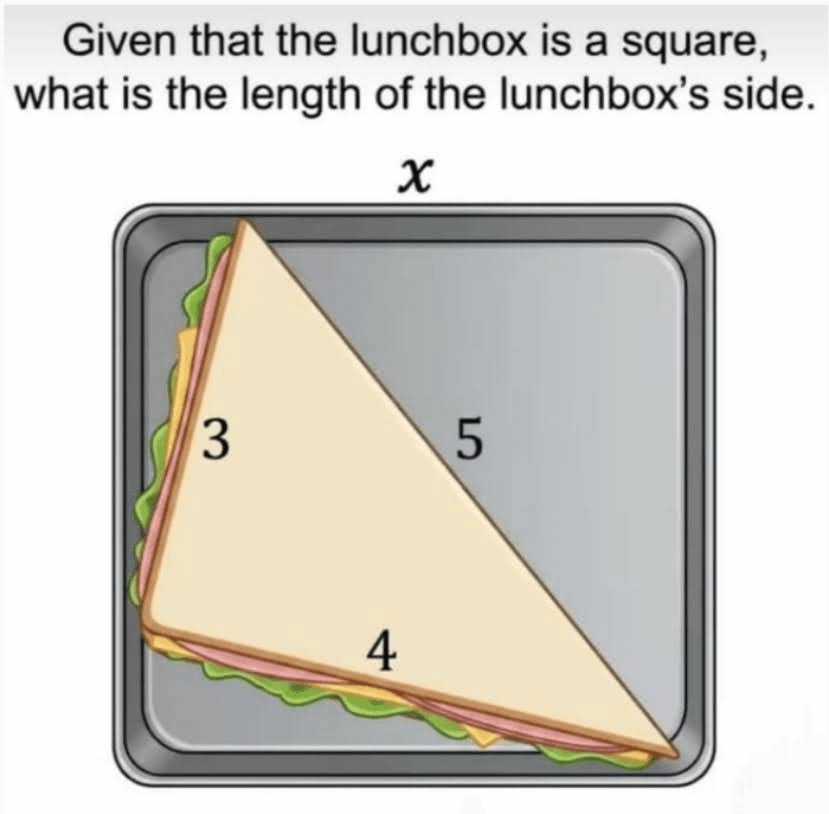
A triangular sandwich with side lengths of 3, 4, and 5 is packed snugly into a square lunchbox. The vertex with the perfect 90^\circ right angle rests flat against the left wall of the box. One of the other two corners touches the top edge, and the third corner exactly hits the bottom-right corner of the lunchbox. Given that the box is a perfect square, we need to find the length x of the lunchbox.
Now let’s begin solving the puzzle step by step.
Because the sandwich has side lengths of 3, 4, and 5, we immediately know it is a classic right-angled triangle. We can use the empty space around the sandwich to form three smaller right-angled triangles in the corners of the box.
To solve this quickly, we are going to use the magic of similar triangles to completely ignore the top-right side of the box and focus entirely on the left wall!
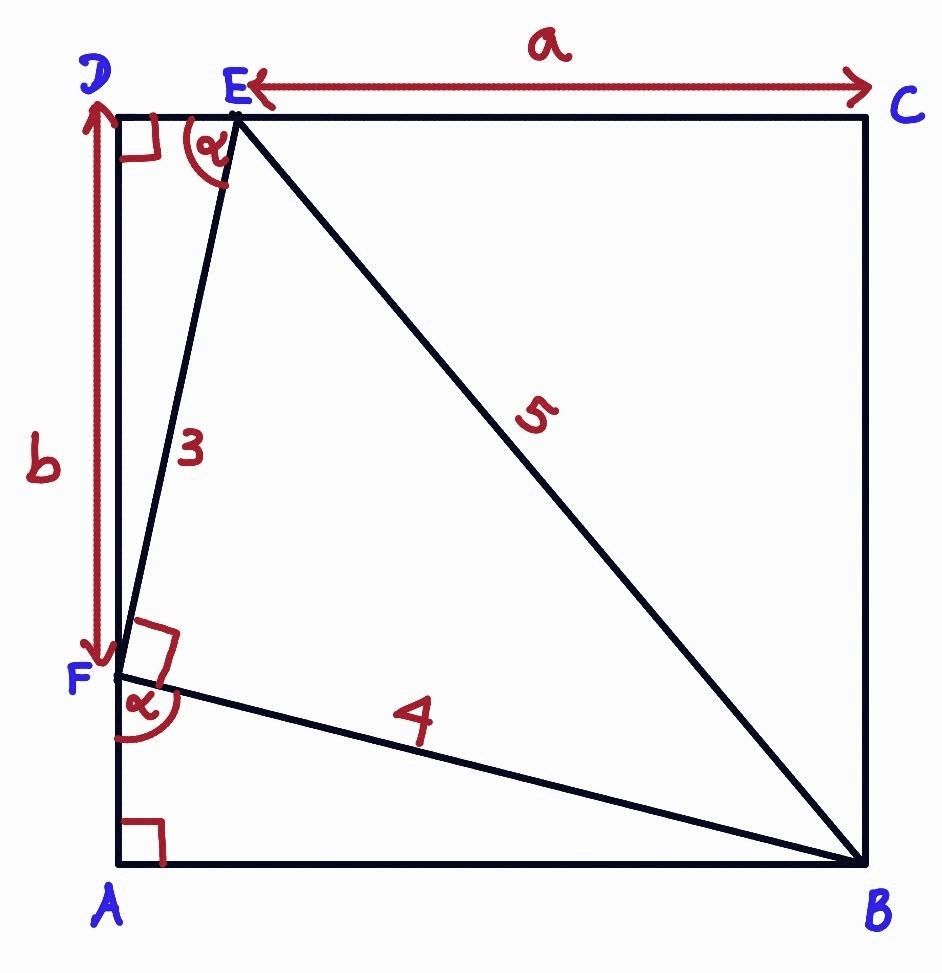
We have the figure below to assist in solving this. Note that for convenience, we have only drawn a triangle instead of the sandwich and a square for the lunchbox.
Look at the left wall of the square box. The 90^\circ corner of the sandwich splits this wall into two segments. Let's call the top vertical segment b. Because the total height of the box is x, the bottom vertical segment must be x-b.
The straight left wall of the box is a 180^\circ line. Since the sandwich takes up exactly 90^\circ of that line, the angles of the empty space above and below the sandwich must add up to 90^\circ.
Let the angle D\hat{E}F be \alpha. This means the angle D\hat{F}E is 90^\circ - \alpha. So, the angle A\hat{F}B must also be \alpha. And now it can be clearly seen that the two triangles \triangle DFE and \triangle AFB are similar. We can now apply our well-known similar triangle conditions.
We have
\frac{DF}{EF}=\frac{AB}{BF}.
So,
\frac{b}{3}=\frac{x}{4}.
Therefore,
b = \frac{3x}{4}.
Finally, to finish off, let’s apply the Pythagorean Theorem for the bottom left triangle:
AF^2+AB^2=BF^2
(x-b)^2+x^2=4^2.
Substitute our value for b:
\Big(x-\frac{3x}{4}\Big)^2+x^2=16
\frac{x^2}{16}+x^2=16.
Multiply the entire equation by 16 to clear the fraction:
x^2+16x^2=16 \times 16
17x^2=256
x^2=\frac{256}{17}.
Therefore,
x = \pm \sqrt{\frac{256}{17}} = \pm \frac{16}{\sqrt{17}}.
Since x is a length and it is positive, we have x = \frac{16}{\sqrt{17}}.