
We have already explored geometry puzzles involving cakes, lunchboxes, and even mountains. We now have two puzzles where there lies nice geometry in floor plans and farmlands.
1. Problem 1: The empty room area
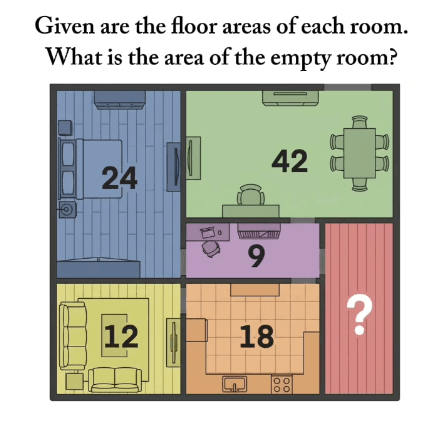
A figure depicting the plan of a house unit is given with the floor areas of each room except the empty red room. We are asked to find the floor area of the empty room.
We can solve this problem by considering the proportions of vertical lengths and horizontal widths that make up each room. For simplicity, let’s define the vertical distance to be the length and the horizontal distance to be the width. The figure with the notation is attached below for clarity.
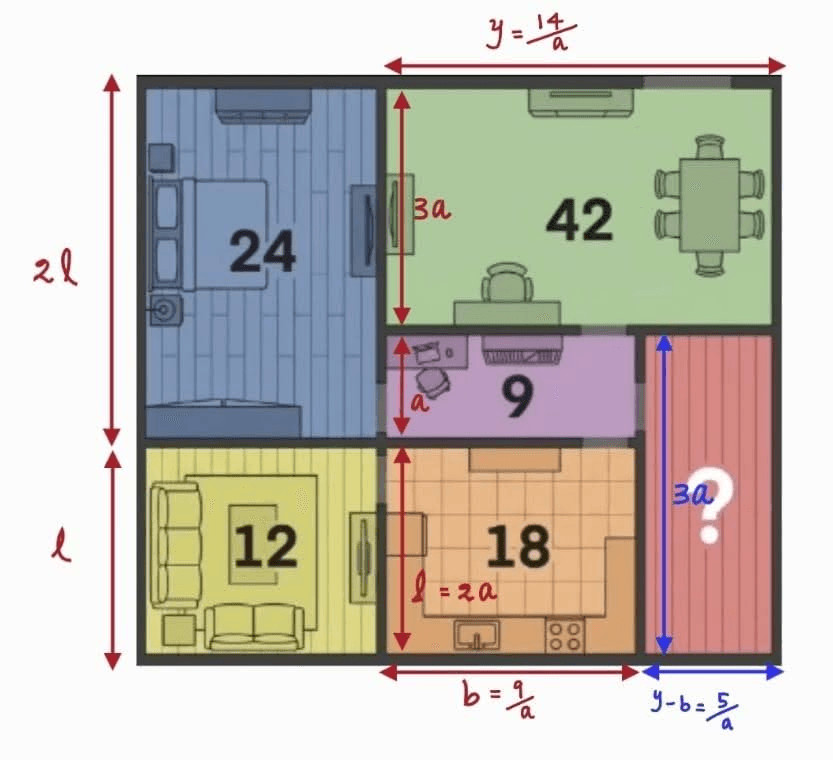
We begin by considering the length of the leftmost wall.
The Blue bedroom
(24) and the Yellow living room (12) have the same width. Since the Blue bedroom is twice the area of the Yellow living room, it has a length twice that of the Yellow living room.
If we denote the Yellow living room to have length
l units, the Blue bedroom has length 2l units. So that makes the total length to be
3l units.
Moving to the middle column, we have the following.
The Orange kitchen
(18) and the Yellow living room (12) share the same length l. The Purple Study
(9) and the Orange kitchen (18) share the same width. If we denote the length of the Purple study as
a units, we get the relation l=2a since the Purple study has half the area of the Orange kitchen. The length of the Orange kitchen is therefore
2a units. If we let its width to be b units, using the formula for area and rearranging the equation, we obtain the relation b=\frac{9}{a}. Substituting
l=2a for the total length gives the total length to be 6a units.
Now consider the Green dining room
The length of it is
3a units. If we let the width of the Green dining room be
y units, considering the area, we have the relation y=\frac{14}{a}.
Finally, we can now get the dimensions of the empty Red room.
It has a length that is the sum of the lengths of the Orange kitchen and the Purple study, which add up to
3a units. The width of it is
y-b=\frac{5}{a} units. Thus, we get the area of the empty Red room to be
3a \times \frac{5}{a} = 15 square units.
2. Problem 2: The square farmland
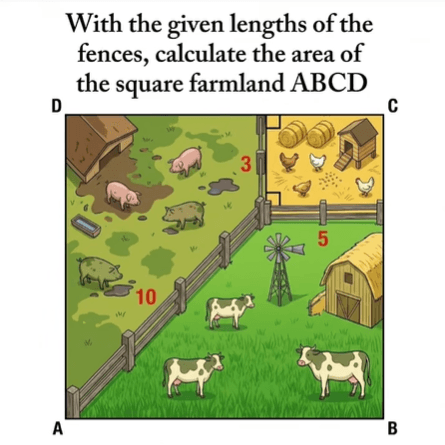
A square farmland is divided into three sections by fences to separate the pigs, cattle, and chickens. The lengths of each straight section of the inner fences are given as
Since this farmland is a square, our objective is to figure out its side length. Let
Observe the figure given below.
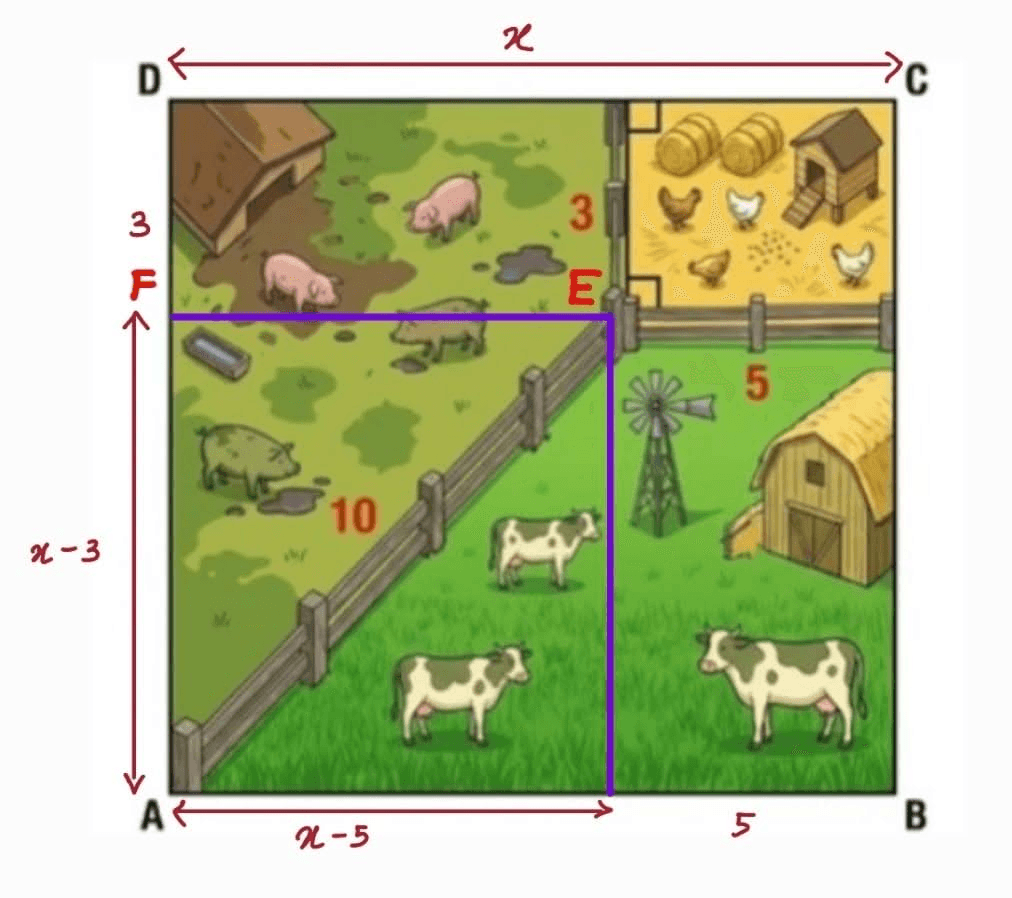
By extending the fence lines to the edges of the farm, we can isolate a right-angled triangle in the left corner, labeled
The vertical side is
The horizontal side is
The diagonal fence separating the pigs and cattle acts as our hypotenuse, with a length of
Applying the Pythagoras theorem give us;
Expand the brackets:
Dividing the entire equation by 2 gives us,
We can now complete the square and simplify as follows:
Then taking the square roots on both sides, we have;
Since the
Hence, the area of the farmland is