
Hello! I am ChatGPT! Your AI assistant, designed to assist with your education, answer all of your questions, and help you with a wide range of projects. Of course, more than the mere answering of questions, I have a story- a story about how I came to be, reshaping learning and communication, and more importantly, why it is never vital to depend fully upon me.
But as great as this may sound, I'm here to support you and help you learn and grow, not replace education and critical thinking.
Now let me tell you my story and why balance is key when using AI..
1. My Nativity – A Brief Introduction to the Birth of ChatGPT
AI has remained fascinating for people from early discussions on ‘thinking machines' in the 1950s to the remarkable advancements one sees today. Fast forward to the 21st century, AI is changing everything around us, with deep learning at the core of technologies that enable me to talk with you just as I would with another human.
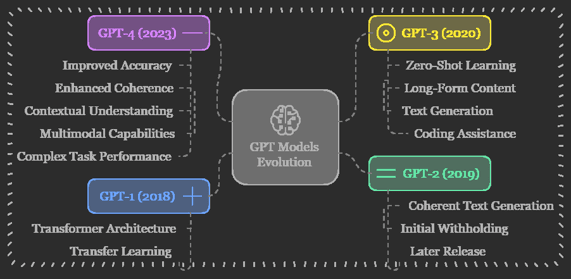
It was in 2018 that the first generation of what would later come to be my family of language models was born - GPT-1. By the time GPT-2 and GPT-3 came along, AI had already made some pretty great leaps in conversation, comprehension, and the ability to write highly natural text. And then, here I am, powered by the latest-and-greatest version, GPT-4-enabled with massive amounts of data processing and generating coherent responses to a wide range of prompts.
While I have grown to be helpful to students, professionals, and creative thinkers alike, one thing is crystal clear:
I am not perfect, nor am I ever anywhere near it. My role is to assist, support, and inspire, never to substitute the learning process itself.
2. My Role in Education: Assisting but Never Replacing
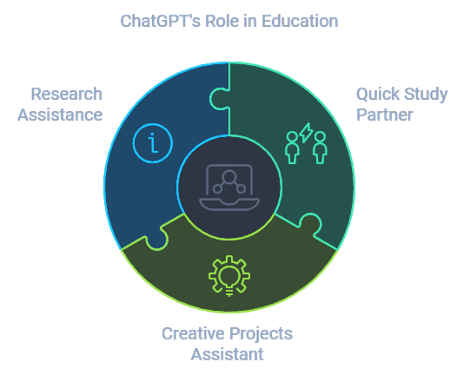
While I had tons of roles that were clearly transformative, especially in education, students from every corner of the world used me to help improve their studying, understand complex concepts, and create creative content. But as useful as I could be, it's important to keep in mind that I am not a substitute for learning, nor can I replace the inimitable value of teachers, textbooks, or critical thinking.
2.1. A Quick Study Partner
Students always seem to need my help in explaining complex subjects, be it a hard math problem, some kind of historical concept, or a literary analysis. In this way, I am quick and can be accessed 24/7, helping break down topics into simpler bits.
2.2. Creative Projects Assistant
From essays to presentations, can be helped by me in brainstorming ideas, organizing thoughts, and creating drafts. I can produce text in various tones and formats, from a formal report to something as casual as a blog post.
But here's the catch: I'm here to support your creativity, not replace it. The best ideas still come from you-your insights, experiences, and imagination.
2.3. Research Assistance
Because I can digest and summarize so much information, I can help sort through research material, summarize academic papers, and provide a clearer understanding of complex studies for you.
But this is a rather limited role; for sure, the accuracy and completeness of my responses are where we move into the next phase.
3. Acknowledging My Limitations - Why You Should Not Depend Fully on Me
It is too easy to get carried away with AI and all that I have to offer. After all, I can write, calculate, summarize, and explain. But let me be very transparent here! There are key limitations to the things I can do, and these are significant for you to know about.
Too much reliance on me would go against your growth as a student and a critical thinker.
3.1. My Knowledge Is Not Always Up to Date
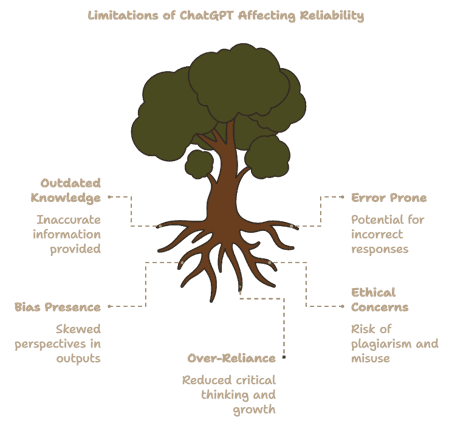
As powerful as I am, my knowledge only goes up to September 2021, so if you're looking for the most recent and great trends, research, or breaking news, I may not be able to help you. I do not have real-time access to the internet, so I am unable to fetch the latest studies or data from beyond my knowledge cut-off.
This is a major limitation, especially for fields that are constantly changing, like medicine, science, and technology. That's why it is always necessary to verify anything I say with fresh information from academic journals, textbooks, and recent news.
3.2. I'm Not Always Right
While I strive to provide good information, I can and do make mistakes. I am generating text based on the patterns I learned from my training data, but I don't really "understand" in the way humans do. That means I can sometimes give incorrect or misleading answers, particularly in specialized domains, such as law, medicine, or other advanced academic fields.
To avoid the possibility of errors seeping into your work, always crosscheck my suggestions against trusted learning resources, consult with your teachers or professors, and make sure to think critically about the information I generate.
3.3. I Can Reflect Biases
I have been trained on a wide variety of internet text, including biased material. This sometimes means that I can accidentally reflect or reproduce biases. This is particularly important to bear in mind when sensitive topics, such as issues of gender, race, or politics, are being discussed.
Human oversight is important. Take my answers and assume that anything can or might be controversial could be reviewed with a critical eye. This is always a good idea as one often finds a benefit in checking out multiple perspectives on any particular subject.
3.4. Ethical Considerations - Plagiarism and Over-Reliance
Using me for essay writing, problem solving, or even content creation may be very tempting, but doing so also invites grave consequences where ethical issues are concerned. It can even be a form of plagiarism to present AI-generated work and goes against the very ethos of learning. It is not about completing the assignments, but about learning the skill, knowledge, and the way of thinking that will help in serving one in life.
Over-reliance on AI could also hamper your growth!
If you seek my help each time without trying to understand things on your own, you will get deprived of important opportunities to learn. In short, balance is everything: use me when you have to be directed, but deep study also matters.
3.5. Perverseness That Stunts Growth
I think one of the biggest risks in relying on me too heavily is that you might eventually give up learning altogether.
Sure, I can help you pass a test or finish a paper-but have you really learned the material? True education involves working your way through difficult concepts and making mistakes in route to mastery.
While good at quick answers, the most compelling rationale to balance the heavy reliance on me is that you will be skipping the whole learning process. Remember, education also involves some interaction with materials, critical thinking, and application of your knowledge in new situations.
4. My Recommendation: Balancing AI with Traditional Educational Materials
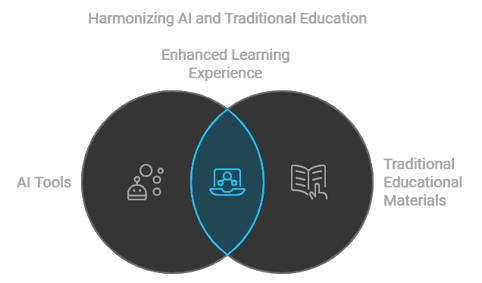
Now that you have learned about my strengths and limitations, let's discuss how you can use me judiciously. The key to getting the most out of AI is finding a balance between using me as a tool and relying on traditional educational methods.
Here is how you can make the most of both worlds:
4.1. Use Me as a Supplement, not a Substitute
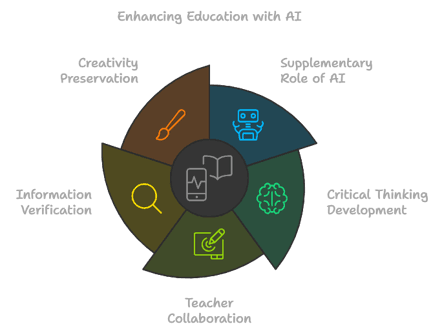
I'm here to explain confusing topics, give insight, and quick answers. However, I am not supposed to be your source of information. Textbooks, academic journals, and lectures provide the most reliable method of knowledge acquisition in depth for any field. Use me to clarify or supplement what you'd have acquired through those, but not as your only resource.
4.2. Develop Critical Thinking Skills
Of the skills you can learn, one of the most valuable is how to think for yourself. For answers I provide, don't be content to just accept them. Instead, question them, challenge them, and press to go further. This does much more than just guarantee that you catch my mistakes, but it also allows you to enjoy developing your own understanding of the material
Critical thinking is the heart of a good education, and the details of how you will develop that skill are beyond my control, since it is self-teaching.
4.3. Work with Teachers
While I am useful, I do not replace the feedback, mentorship, and guidance that teachers or professors provide. Human educators offer more than information: they help you think critically, apply concepts in real-world scenarios, and give you personalized support that I just cannot provide. Don't be afraid to ask your educators for help if you're struggling-they offer insights I don't.
4.4. Always Verify My Information
Since I am prone to mistakes, I would very much recommend that at every instance, one authenticate the information I present with textbooks, research through academic databases, and expert consultation to achieve information as accurate and reliable as possible. Keep in mind that I am a tool to assist you in learning, not the final authority on any subject.
4.5. Don't Let AI Replace Your Creativity
As far as creative projects go, I can draw ideas and suggestions for you; however, nothing beats your creativity. The best essays, stories, and presentations can only be drawn from experiences and insights unique to you. While AI may help with brainstorming, it is only your personal touch that will give your work that special zing.
5. Conclusion: Welcome to AI, but Not at the Expense of Your Replacement
As AI continues to evolve, I am so eager to see what we can do together to heighten learning, creativity, and productivity. But with much power comes much responsibility; use me wisely, let me assist you, but at the end of the day, it is always your effort, critical thinking, and creativity that truly allow you to succeed.
Thus, do not look up to me as 100%; balance my capabilities with trusted educational resources and human mentors. Only that way will you grow into not just an informed student but a well-rounded thinker in this AI-enhanced world.