
1. What is an equation?

As we know, a balance scale is used to compare or measure the weights of two objects and if both sides bear the same weight, we say that the scale is in balance. In the above picture, the man on the left side and the woman on the right side have the same weight because the scale is now in equilibrium. Similarly, when the two mathematical expressions or terms are equal to each other, we can write an equation by keeping two expressions on two sides of an equals symbol(=) and it will form an equation. The formation of an equation will be as follows:
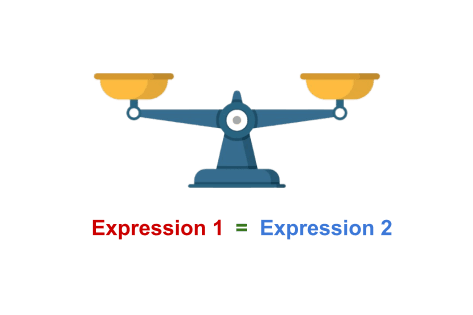
For example,
Let’s take a few more examples for equations for a better understanding.
15 - 4 = 11 12 - 3 = 5 + 4 \frac{20}{5} = 10 - 6 9 \times 2 = 6 \times 3 10 \times 2 + 4 = 5^2 - 1
Now, let’s see how we can workout with equations. As we discussed above, the functionality of the balance scale and equations is almost the same. In the above picture, the scale is in balance with the man and woman. Suppose that the woman is holding a cat. What will happen now to the scale? Since the woman’s side got heavier because of the cat, that side will go down. Now, the scale is out of balance.
Likewise, if we make a change to only one side of an equation, it will affect the equality of the equation, causing the two sides to no longer be equal. As a result, it will no longer be an equation. Therefore, if we work out an equation, we must maintain the equality by applying the same operation on both sides using the same value.
Consider the following examples:
15 - 4 = 11 15 - 4 + 1 = 11 + 1 (Adding 1 to both sides) 12 - 3 = 5 + 4 2 \times (12 - 3) = 2 \times ( 5 + 4) (Multiplying both sides by 2)
There are several rules that we should follow while working out equations to maintain the equality of equations. These are called the properties of equality. Let’s learn about them.
2. Properties of equality
2.1. Addition property
When the same number is added to both sides of an equation, the equation remains balanced. Let
If
Example:
Accordingly,
Hence, the equality remains true.
2.2. Subtraction property
When the same number is subtracted from both sides of an equation, the equation remains balanced. Let
If
Example:
Accordingly,
Hence, the equality remains true.
2.3. Multiplication property
When both sides are multiplied by the same number in an equation, the equation remains balanced. Let
If
Example:
Accordingly,
Hence, the equality remains true.
2.4. Division property
When both sides are divided by the same number in an equation, the equation remains balanced. Let
If
Example:
Accordingly,
Hence, the equality remains true.
2.5. Symmetric property
Even if the two sides are interchanged in an equation, the equation remains balanced.
Let
If
Example:
Suppose we are given that
Calculating both sides,
Therefore, if
Therefore, an equality remains true when its two sides are interchanged.
This is called the Symmetric Property of Equality.
2.6. Transitive property
If one expression is equal to a second expression, and the second expression is equal to a third expression, then the first expression is equal to the third expression.
Let
If
Example:
Let us use
Since
This is called the Transitive Property of Equality.
When we work out two equations together, there are several rules that we should follow to maintain the equality of equations. These are called the properties of equality for two equations. Let’s learn about them.
3. Properties of equality for two equations
3.1. Addition property of equality for two equations
Let
If
Example:
Let us use the two equations
Adding the left-hand sides;
Adding the right-hand sides;
Therefore,
This proves the Addition Property of Equality for Two Equations:
3.2. Subtraction property of equality for two equations
Let
If
Example:
Let us use the two equations
Subtracting the left-hand sides;
Subtracting the right-hand sides;
Therefore,
This proves the Subtraction Property of Equality for Two Equations:
3.3. Multiplication property of equality for two equations
Let
If
Example:
Let us use the two equations
Multiplying the left-hand sides;
Multiplying the right-hand sides;
Therefore,
This proves the Multiplication Property of Equality for Two Equations:
3.4. Division property of equality for two equations
Let
If
Example:
Let us use the two equations
Dividing the left-hand sides;
Dividing the right-hand sides;
Therefore,
This proves the Division Property of Equality for Two Equations:
Examples
Mark subtracted the equation from
10 - 3 = 7 from 10 + 5 = 20 - 5 and formed the equation (10 + 5) - (10 - 3) = 7 - (20 - 5). Is this equation true? If not, show that it is wrong.
This equation is not true.
Proof:
The newly formed equation is
Left side is
Two sides are not equal and this equation is not true.
Consider the following equation.
Subtracting
Subtracting
Even after subtracting
Use the appropriate property of equality to perform the given operation on the equations. Show all your working and verify whether the resulting equation is true.
Consider the following two equations. Add the two equations and show the equality remains true after adding two equations.
Paul divided the equation
11 + 4 = 9 + 6 by the equation 2 + 3 = 5 \times 2 - 5. He then wrote the new equation as \frac{11 + 4}{2 + 3} = \frac{5 \times 2 - 5}{9 + 6}. Is this new equation true? If not, where did Paul go wrong? Consider the equation
\frac{4}{5} = \frac{12}{15}. If we take the reciprocal of both sides of the equation, are the two reciprocals equal? Prove your answer.
Answer